
Tree Removal in Orlando, FL
A tree that has to come down in Orlando is rarely a tree nobody liked. It is the laurel oak that has leaned further since the last storm, the pine with a hollow at the base, or the water oak whose canopy now sits over the roof and whose roots are under the drive. The decision is not really about the tree. It is about what happens underneath it if the tree decides first — and in a city where the sand drains fast, the wind arrives in a season, and anything over ten inches across is protected by code, that decision has a deadline and a permit attached to it.
Why property owners in Orlando choose a removal that is planned
Most removals on a residential lot are not emergencies. They are decisions that were postponed. A tree that has started to fail keeps failing at a predictable pace: the crown thins, a scaffold limb dies, a seam opens at the union, the soil on one side of the base lifts. Each of those is easy to live with for another season and each one shortens the list of safe options.
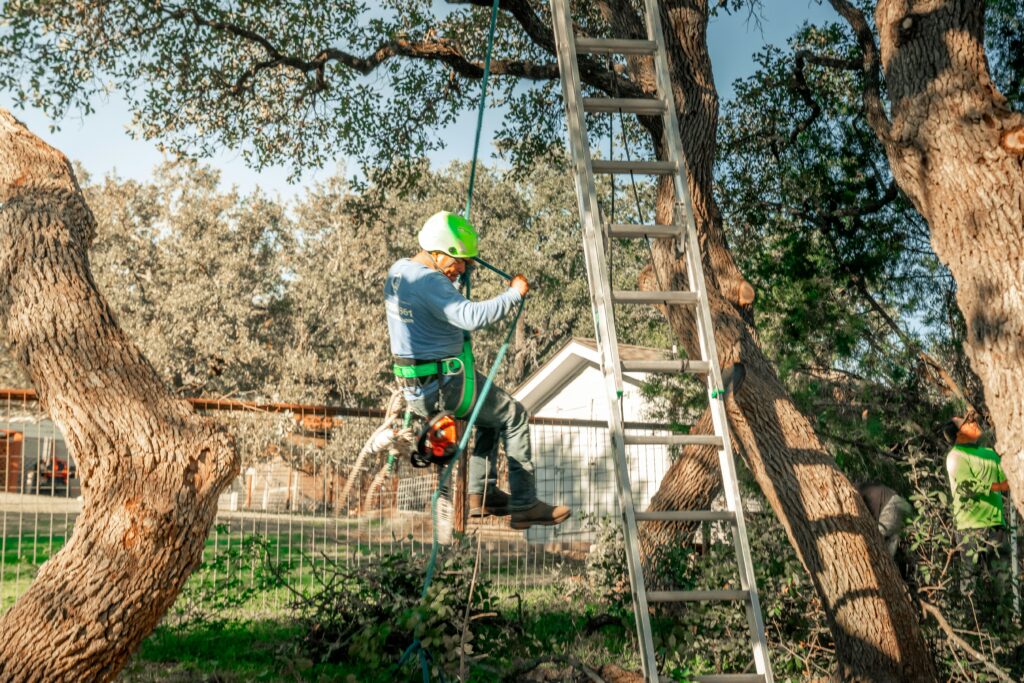
A planned removal sets the terms. The drop zone is chosen before anything is cut, the pieces are lowered rather than dropped, the utility is called if a service drop crosses the work zone, and the stump is ground and the debris hauled in the same visit. A removal that happens because a tree has already landed on a roof is the same work with a worse starting position: a damaged structure underneath, an access route that has to be cleared first, and a household that has already lost a night.
The other reason to plan is the code. The City of Orlando treats any tree with a diameter at breast height of ten inches or more as a protected tree, and removal of a non-exempt tree at that size is prohibited without a Tree Removal Permit first. Discovering that with a crew already on site is the worst version of the job, so the permit question is settled while the work is still a plan.
Tree Service Company Orlando works from 1018 E Concord St in the 32803 ZIP, and removal work is booked around the tree, the access and what is underneath it — never around a figure for a tree nobody has walked up to.
10 in
The trunk size at which Orlando protects a tree
COMPLETE TREE CARE SOLUTIONS
Why it matters that the removal happens before the wet season
Orlando does not have four equal seasons. It has a wet season and a dry one, and the National Weather Service office that covers east-central Florida puts the average onset of the wet season in the last week of May — between 26 and 30 May depending on the year. From then until roughly October the ground is regularly saturated, and saturated ground is where a root plate that was already marginal stops holding.
The wind that arrives with that season is not abstract. When Hurricane Milton crossed the peninsula in October 2024, the observing site at Orlando Executive Airport recorded sustained winds of 43 knots with a gust to 63 knots, and 6.87 inches of rain. Hurricane Irma in 2017 crossed central Florida as a category 1 storm with its centre just to the west of the city. Neither of those is a once-in-a-lifetime event on this coast; they are the top of a range that a summer thunderstorm can touch for ten minutes with the same effect on a tree that was already hollow.
Wet ground also changes the work itself. Orlando fine sand takes a machine well when it is dry and badly when it is saturated, so a removal scheduled in a wet week leaves ruts that take longer to put right than the removal took to do. The dry months are the easy window for the ground, the access and the rigging, and a tree that is already showing a defect does not need to wait for the convenient one.
Base checked first
Root plate, cracks and soil movement before the crown
HOW A REMOVAL IS SEQUENCED
What backs the work
There is no credential in this business’s ledger to point at, and inventing one would be the easiest thing on this page to do and the worst reason to hire anybody. What can be pointed at is the standard the work is held to: the City of Orlando’s own protected-tree rules, the county’s tree removal permitting process, and the published University of Florida research on how and why trees in this state fail. Those are checkable by anyone, and they decide how a removal here is sequenced.
The ten-inch protected-tree line
The City of Orlando defines a protected tree as any existing tree with a diameter at breast height of ten inches or more, measured at four and a half feet above the ground, with invasive exotic species treated as replaceable rather than protected. Removing a non-exempt tree at or above that size needs a Tree Removal Permit before any cutting. Trees the Parks Official designates as Historic — defined in the code as a healthy tree with a trunk caliper of thirty inches or more — and Specimen trees carry heavier protection, and removal without a permit can carry a penalty of up to fifteen thousand dollars. Ordinance 2021-48 raised this threshold from six inches, so older advice found online is out of date.
Orlando fine sand and what it does to a root plate
The soil under most of this city is the Orlando series: a very deep, well-drained, rapidly permeable fine sand formed in marine and fluvial deposits, strongly acid through the profile, on slopes of nought to eight per cent. It drains so well that a tree can look healthy through a dry spring and still be sitting in a root plate that has lost its grip, because the same permeability that prevents standing water also means the sand holds little cohesion when it is saturated. The practical consequence is that the base is read before the crown on every removal here — soil proud on one side, a crack at the flare, or a lean that has changed is a different job from a straight tree on firm ground.
Codominant stems and included bark
University of Florida extension guidance on recognising conditions that raise the likelihood of failure lists codominant stems among the defects a homeowner can see without equipment: two stems of similar size rising from one point, especially where the union forms a narrow V and bark is pressed into the joint. That included bark weakens the connection, and the failure happens at the union rather than in the wood. A tree with that shape can stand for a long time and then open in one gust. It is also the defect most often mistaken for a fork that “looks fine”, which is why the union is inspected on the ground before a removal method is chosen, and why a cable or a reduction is sometimes the better answer than a saw.
The removal window the calendar sets
The wet season dates are not folklore; the National Weather Service publishes them, and the last week of May is the average onset for this part of the state. A removal done in the dry months can use the ground, the access and the long daylight, and it can be scheduled without watching a forecast. A removal done in a wet week works around saturated sand, a shorter day and the possibility that the access has to be matted before a machine crosses it. The tree does not care about the calendar. The property underneath it does, because a failed tree in a saturated month takes the fence, the drive and sometimes the roof with it, and the clean-up afterwards is a bigger job than the removal would have been.
Drop zone set
Wider than the tree, marked and kept clear for the whole job.
Utility called
Before anything moves, if a service drop crosses the work zone.
Sections, lowered
Rigged and lowered from the top rather than dropped.
Debris in one pass
Wood and brush leave with the crew rather than at the curb.
TREE SERVICES
Tree work that runs alongside a removal
A removal rarely arrives alone. The stump, the debris and the trees beside it are usually part of the same site.
Tree Removal
Removing a tree that has failed, is failing, or cannot stay where it stands.
Tree Trimming
Clearing growth back off a roof, a drive or a service drop without cutting into the structure.
Tree Pruning
Structural pruning on a tree that is staying, including deadwood and reduced limbs.
Stump Grinding
Grinding a stump below grade and bringing the ground back to a level a mower can cross.
Land Clearing
Taking brush, volunteer growth and unwanted trees off a lot before anything is built.
Debris Removal
Hauling off what a storm or another crew left behind, in planned loads.
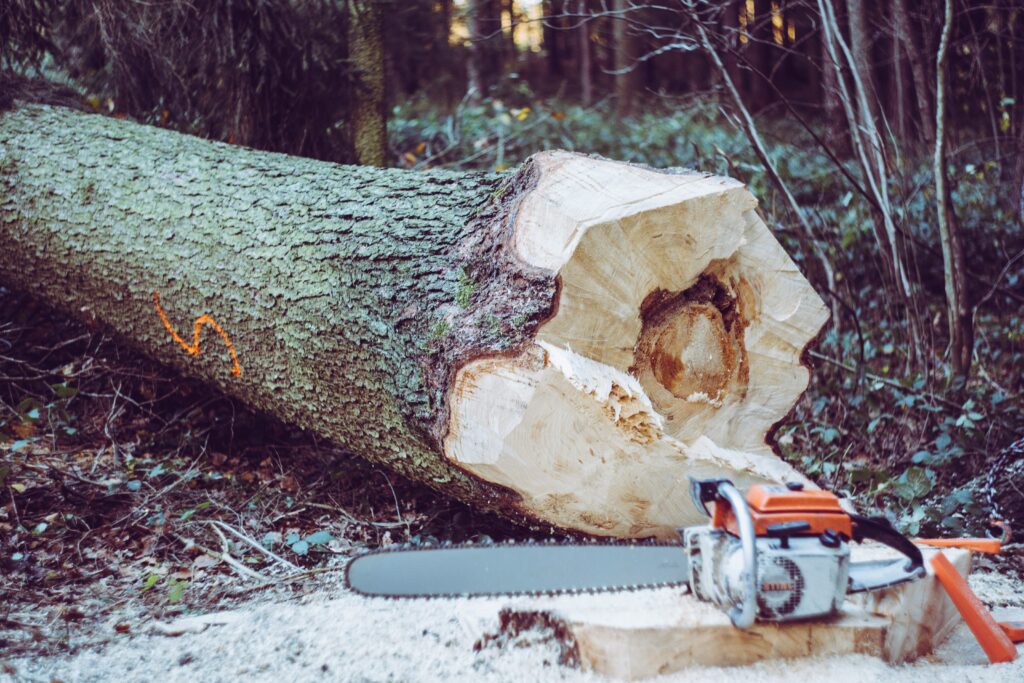
What a removal in Orlando covers
The tree, the stump ground below grade, the debris in planned loads, and the ground brought back so the lawn can be walked on.
The scenario that catches homeowners: the tree that has already moved
The call that needs a decision this week usually starts with a lean that changed. The tree was always a little off vertical, and now the soil at the base is proud on one side, or a crack has opened at the union, or the canopy has shifted relative to the trunk. Nothing has fallen, which is exactly why it is easy to leave for another month.
A moved tree is treated as a removal until it is shown otherwise, and the showing is a look at the base rather than a feeling about the crown. That means the root plate, the soil on the tension side, the union and the crown, in that order. If the plate has lifted, the tree is scheduled with the access closed and the utility called, and the work starts at the top with every piece lowered. If the movement is old and the base is sound, the tree may be reduced instead, which keeps it and takes load off the side that is carrying it.
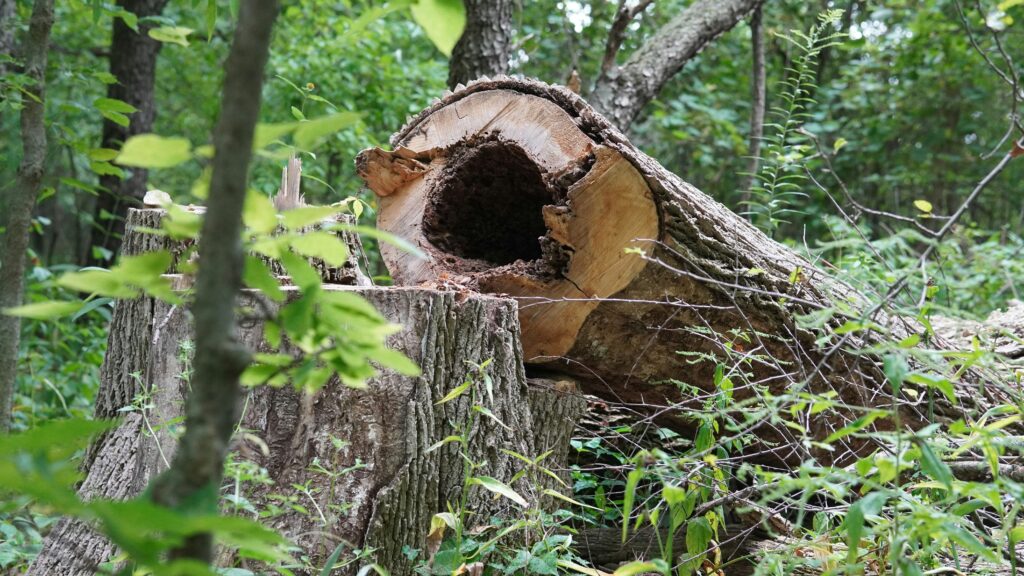
The second version of this call arrives after a storm has taken part of the tree. A split trunk with one half still standing is the most dangerous shape on a residential lot, because the remaining half is carrying a load it was never shaped to carry. That is a removal, and it is a removal that starts at the top and works down, with nothing standing underneath.
The third is a property being sold. An inspector’s note about a leaning tree or a hollow base turns into a negotiation, and a removal completed before the listing turns a contingency into a known quantity. The written scope and the disposal record are what make it one.
The fourth is the tree the owner wants to keep. A live oak is one of the most wind-resistant trees available in this state, and it is also the one most often planted somewhere it cannot stay — the roots lift and crack curbs, sidewalks and driveways when the tree is planted too close, and a live oak can reach sixty to eighty feet tall with a spread of sixty to a hundred and twenty feet. When the tree is worth keeping, the work is structural pruning and a protected root zone, not a saw. When it is not, the honest answer is a removal, and it is better said early.
What a removal is not
It is not a tree cut to a stump and left. The stump, the wood and the ground are part of the job.
Reading the base first
Root plate, soil movement and cracks at the flare decide the method more than height does.
Working around what stays
Fence, drive, roof and the neighbour’s side of the line are treated as fixed points.
The permit question
A ten-inch protected tree needs a permit before cutting, so it is settled while the job is still a plan.
How a removal runs
Four stages, in this order, on every removal.
Walk and measure
Check the base, measure diameter at breast height and read the access.
Check the permit
City or county requirement settled before a date is set.
Set and cut
Drop zone marked, utility called, sections lowered.
Grind and clear
Stump below grade, hole levelled, debris hauled.
Before the next storm decides for you
A leaning tree with a lifted base is a removal waiting on weather. Book the walk while the ground is dry.
Next step
Call (407) 853-8735 with the address, what the tree is doing and whether anything is touching a line or a structure. Tree Service Company Orlando will look at the base, the work zone and what is underneath, check whether the city or the county requires a permit for that tree at that size, and put the scope in writing before a date is set.
Where removals are done
Orlando and the towns around it: Winter Park, Maitland, Edgewood, Belle Isle, Pine Hills, Doctor Phillips, Bay Hill, Hunters Creek, Lake Buena Vista, Windermere, Ocoee and Altamonte Springs.
Tree removal questions from Orlando property owners
Will the work damage the lawn, the drive or the fence?
It can if it is not planned. Mats go down where a machine crosses a finished surface, the drop zone is set to keep pieces off the lawn where the geometry allows, and the ground is raked at the end. Saturated Orlando sand is the main risk, which is why the timing of a removal is discussed before the date is fixed rather than on the morning.
Who is responsible when a tree crosses a property line?
A tree on a boundary is a conversation with the neighbour before it is a job for a crew. The work is planned so nothing lands on the other side of the line, the access is agreed in advance, and the scope records what was decided. In Florida, a healthy tree that falls across a line is generally the responsibility of whoever owns the ground it lands on, which is a further reason to deal with a leaning tree while it is still standing.
Do I need a permit to remove a tree in Orlando?
For most residential removals of a tree at or above ten inches in diameter at breast height, yes. The City of Orlando prohibits removal of a non-exempt protected tree without a Tree Removal Permit, and invasive exotic species are handled as replaceable rather than protected. In unincorporated Orange County the requirement runs through the county’s tree removal permit, which asks for a tree survey and identification of heritage and specimen trees. The permit is checked before a date is booked.
How is the ten-inch measurement taken?
At breast height, which the code sets at four and a half feet above the ground, measured around the trunk. A tree that forks below that height is measured at the narrowest point beneath the fork. It is worth measuring before assuming a tree is exempt, because the difference between nine inches and eleven inches is the difference between a saw and a permit application.
What happens to the stump and the wood?
The stump is ground below grade as part of the removal and the hole is brought back to level so a mower can cross it. Trunk wood and brush leave in planned loads rather than being stacked at the curb, because a mature tree produces far more material than a residential collection will take. Where the client wants firewood, trunk sections can be cut to length and stacked instead of hauled.
Can the tree be saved instead of removed?
Often a tree can. A single broken limb on a sound stem is a pruning job, and a live oak with a narrow union can sometimes be cabled or reduced rather than removed. What changes the answer is the base: a lifted root plate, a hollow at the flare or a crack running into the ground is not something pruning improves. University of Florida research also cautions against reading every visible defect as a prediction of failure, which is why the assessment looks at the whole tree rather than one symptom.
Related guides: the complete tree removal guide and the 9 signs a tree needs removal.